Tired of throwing money at oil companies and your local utility? You can fight back by eliminating the energy waste in your life. Consider the following:
1. If you have an attic, you undoubtedly are wasting money on your heating bill. Take a close look at the entrance to the attic. If it is a drop down from the ceiling, hot air is moving up and through it.
2. When considering the layout of solar panels on your home, it is vital that you consider how to maximize the exposure to the sun. This is known as “orienting” and involves placing the panels in such a position that they receive as much sun as possible.
3. Check the Pressure in Your Tires – Under-inflated tires can reduce gas mileage by 3 to 5 percent and wear out the tires. Make sure to maintain pressures at the top end of the suggested psi of the tire.
4. Programmable Thermostats Save Money – Heating your home can be expensive. Programmable thermostats let you save money by setting the times when heating should occur and when it should not such as when you are at work.
5. Cut Lighting Costs – The lights in your home are huge money wasters. Switch to CFL lights. They last up to 10 times longer and cost less to run.
6. Heating Two Story Homes – Heat moves up, so you can manipulate it with your multi-level home. Close all vents other than on the lowest floor. Heat will migrate up and you will spend less.
Geothermal Heat Pumps
7. The Electrical Grid – When it comes to renewable energy, you will quickly hear the term electrical grid. It refers the platform maintained by utilities across the country. With solar, you can feed energy into the grid when not using it.
8. Solar power not only saves you money, but helps stop global warming.
9. Window Energy Costs – Windows allow for the transfer of heat in a big way. Closing curtains or blinds over them at night can cut down on the rate of heat loss, saving you tons on your bill.
10. Changing Car Filters – Two energy wasters on your car are the fuel filter and air filter. Change them every 3,000 to 6,000 miles. Any oil change location can do it.
You should notice that the above tips do not really require you to make any drastic changes in your life. It is more a matter of eliminating the sloppy things to save some serious money.
Showing posts with label Clearwater Geothermal. Show all posts
Showing posts with label Clearwater Geothermal. Show all posts
Wednesday, October 21, 2009

Tuesday, October 20, 2009
Being Greener When You Rent
Renting can be frustrating when you want to go green. There are a lot of things you just don’t have control over. You generally don’t own the appliances, can’t install solar panels, etc. It gets annoying sometimes.
I deal with this a lot as I do still rent. We’re fortunate enough to be renting a house rather than an apartment, but there are still a lot of limitations.
Start By Saving Energy
Even when you can’t replace that cranky old refrigerator, you can still save energy. Start with the light bulbs. Switch out to compact fluorescent lights, or CFLs. In many areas you can find them at a discount through your local electric company. I’ve seen them under $2.50 for a 3-pack in my area due to discounts run through my power company. Take advantage.
There is one catch to CFLs if you have a lot of closed fixtures. The standard spiral bulbs don’t work as well in closed fixtures. According to energystar.gov, you are best off using a reflector CFL in these areas. Similarly, if you have dimmer switches, you will want to be sure that your bulbs will work with these.
Clearwater Geothermal Air Conditioning
Also try to find out about recycling these, as they have a small amount of mercury and should not be just thrown in the trash. In my area Kohl’s recycles them.
You should also think more about when you are using electricity. Power down the computer if you won’t be using it for a time. Unplug appliances that don’t need to be plugged in all the time. Unplug the cell phone charger and other chargers.
Power strips can also be a big help. Use them to shut off all power to multiple items at once. This takes care of the “phantom load” that many electrical items have where they use electricity even when off. Often this is to run a clock or other nonessential. If you don’t need it to have electricity 24/7, find a way to make shutting it off all the way easy.
Watch for Green Apartments
You may not be able to move into one right now, but in some areas green apartments are turning up. Just a few miles from where I live, there’s a new apartment complex that is powered by solar power. Believe me, I would have loved to get on that list, but by the time I heard of it, the list was full.
I expect green apartments to be a trend. It’s a good value for the landlords and very appealing to many renters.
Tampa Geothermal Installation
Encourage Green Habits
Perhaps one of the biggest challenges is that you may not have access to many of the basic things homeowners take for granted. For example, recycling may or may not be available in some apartment communities, even if single family homes are required to recycle.
If your complex doesn’t recycle, talk to the rental agents about it. If they learn there is a demand for it, they’re more likely to sign up for recycle bins to be put out by the trash bins.
Being green in a rental situation is more difficult, but it is not impossible. These steps can help you to get onto the right path.
I deal with this a lot as I do still rent. We’re fortunate enough to be renting a house rather than an apartment, but there are still a lot of limitations.
Start By Saving Energy
Even when you can’t replace that cranky old refrigerator, you can still save energy. Start with the light bulbs. Switch out to compact fluorescent lights, or CFLs. In many areas you can find them at a discount through your local electric company. I’ve seen them under $2.50 for a 3-pack in my area due to discounts run through my power company. Take advantage.
There is one catch to CFLs if you have a lot of closed fixtures. The standard spiral bulbs don’t work as well in closed fixtures. According to energystar.gov, you are best off using a reflector CFL in these areas. Similarly, if you have dimmer switches, you will want to be sure that your bulbs will work with these.
Clearwater Geothermal Air Conditioning
Also try to find out about recycling these, as they have a small amount of mercury and should not be just thrown in the trash. In my area Kohl’s recycles them.
You should also think more about when you are using electricity. Power down the computer if you won’t be using it for a time. Unplug appliances that don’t need to be plugged in all the time. Unplug the cell phone charger and other chargers.
Power strips can also be a big help. Use them to shut off all power to multiple items at once. This takes care of the “phantom load” that many electrical items have where they use electricity even when off. Often this is to run a clock or other nonessential. If you don’t need it to have electricity 24/7, find a way to make shutting it off all the way easy.
Watch for Green Apartments
You may not be able to move into one right now, but in some areas green apartments are turning up. Just a few miles from where I live, there’s a new apartment complex that is powered by solar power. Believe me, I would have loved to get on that list, but by the time I heard of it, the list was full.
I expect green apartments to be a trend. It’s a good value for the landlords and very appealing to many renters.
Tampa Geothermal Installation
Encourage Green Habits
Perhaps one of the biggest challenges is that you may not have access to many of the basic things homeowners take for granted. For example, recycling may or may not be available in some apartment communities, even if single family homes are required to recycle.
If your complex doesn’t recycle, talk to the rental agents about it. If they learn there is a demand for it, they’re more likely to sign up for recycle bins to be put out by the trash bins.
Being green in a rental situation is more difficult, but it is not impossible. These steps can help you to get onto the right path.
Monday, September 28, 2009
AC Doesn't Cool
What to do when Room Air Conditioner Doesn’t Cool
If your room air conditioner doesn’t cool then you may need to clean it or recharge it with refrigerant. You can clean an air conditioner yourself by disassembling the unit yourself or you can call a professional. But before doing the job yourself you need to read the system manual and make sure you have the right skills and tools to do the job. Here is what you may need to do:
If that does not do the work then clean the evaporator and condenser coils. If it still doesn’t works then you may have to call some professional or call the company’s customer care.
Florida Air Conditioning
If your room air conditioner doesn’t cool then you may need to clean it or recharge it with refrigerant. You can clean an air conditioner yourself by disassembling the unit yourself or you can call a professional. But before doing the job yourself you need to read the system manual and make sure you have the right skills and tools to do the job. Here is what you may need to do:
- 1) Unplug the unit and remove it very carefully from the window or the wall and place it somewhere outdoors where you can work on it.
- 2) Remove the grille and filter and unscrew the metal case while making sure that you do not damage the coil’s fins.
- 3) Wash out the filter or replace it with a new filter.
- 4) Clean the inside coil’s fins by using a vacuum with a soft brush attachment
- 5) From the fan side, spray water back through the fins. You will have to protect the wiring and motor with plastic.
- 6) Clean the unit up with a rag and allow the system to dry completely.
- 7) You can also lubricate the motor as per the “Repair and Care” manual’s instructions.
- 8) Then reassemble and reinstall the unit.
If that does not do the work then clean the evaporator and condenser coils. If it still doesn’t works then you may have to call some professional or call the company’s customer care.
Florida Air Conditioning
Thursday, September 10, 2009
Crash Course in geothermal heat pumps!
Found a website with some great information on geothermal energy! A lot of helpful graphs and visual aids. Just a snippet below, but you can view the full website at http://www.fossilfreedom.com/geothermal.html
Crash Course in geothermal heat pumps...
"Studies show that approximately 70 percent of the energy used in a geothermal ground contact heat exchange heating and cooling system is renewable energy from the ground. The remainder is clean, electrical energy which is employed to concentrate heat and transport it from one location to another. In winter, the ground soaks up solar energy and provides a barrier to cold air. In summer, the ground heats up more slowly than the outside air.
Ground contact geothermal systems do the work that ordinarily requires two appliances, a furnace and an air conditioner. They can be located indoors because there's no need to exchange heat with the outdoor air. They're so quiet homeowners don't even realize they're on. They are also compact. Typically, they are up to six times less expensive to operate since they are far more efficient then any fossil fuel based system."
Tampa Geothermal Air Conditioning
Crash Course in geothermal heat pumps...
"Studies show that approximately 70 percent of the energy used in a geothermal ground contact heat exchange heating and cooling system is renewable energy from the ground. The remainder is clean, electrical energy which is employed to concentrate heat and transport it from one location to another. In winter, the ground soaks up solar energy and provides a barrier to cold air. In summer, the ground heats up more slowly than the outside air.
Ground contact geothermal systems do the work that ordinarily requires two appliances, a furnace and an air conditioner. They can be located indoors because there's no need to exchange heat with the outdoor air. They're so quiet homeowners don't even realize they're on. They are also compact. Typically, they are up to six times less expensive to operate since they are far more efficient then any fossil fuel based system."
Tampa Geothermal Air Conditioning
Wednesday, August 26, 2009
Geothermal AC on Fox News
Watch above or check out this at Foxnews!
TAMPA - As those high summer temps continue, so do the high electric bills. So how would you like to cut your air conditioning bills in half? One Bay Area company says it can help you do it by tapping into the earth. It's called a geo-thermal AC system, and it could bring savings of thousands of dollars a year.
Tuesday, August 18, 2009
A Window of Opportunity
 Renewable Energy Source [link]
"There can be no doubt that a society rooted in the soil is more stable than one rooted in pavements." - Aldo Leopold
Monday, August 17, 2009
Plug into the Earth!
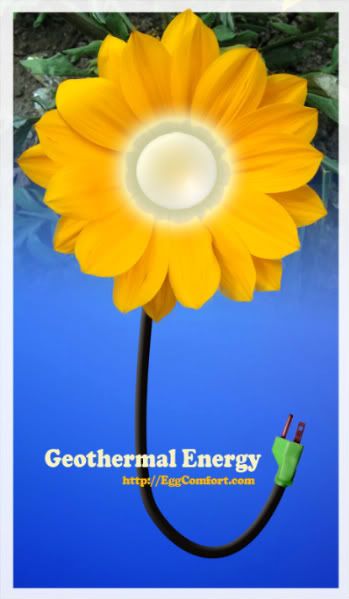
A lot of people don't realize there's a renewable energy source right beneath their feet!
Though heat pumps are gaining in popularity they are still relatively unknown despite their high efficiency. Aside from helping the environment, after an initial investment they can also drastically reduce your monthly energy bill. For more information about geothermal energy, you can check out http://EggComfort.com
Though heat pumps are gaining in popularity they are still relatively unknown despite their high efficiency. Aside from helping the environment, after an initial investment they can also drastically reduce your monthly energy bill. For more information about geothermal energy, you can check out http://EggComfort.com
Also check out my deviantart account!
Thursday, August 13, 2009
Geothermal Put Simply

While temperatures above ground change a lot from day to day and season to season, temperatures in the upper 10 feet of the Earth's surface hold nearly constant between 50 and 60 degrees Fahrenheit. For most areas, this means that soil temperatures are usually warmer than the air in winter and cooler than the air in summer. Geothermal heat pumps use the Earth's constant temperatures to heat and cool buildings. They transfer heat from the ground (or water) into buildings in winter and reverse the process in the summer.
According to the U.S. Environmental Protection Agency (EPA), geothermal heat pumps are the most energy-efficient, environmentally clean, and cost-effective systems for temperature control. Although, most homes still use traditional furnaces and air conditioners, geothermal heat pumps are becoming more popular. In recent years, the U.S. Department of Energy along with the EPA have partnered with industry to promote the use of geothermal heat pumps.
Thursday, August 6, 2009
How to make an easy worm compost system.
Using worms in a compost is a fast and efficient way to create marvelous compost and fertilizing liquid. "Vermiculture" is gaining in popularity for many reasons, not the least of which is that worm compost bins are relatively small, odorless, and can be maintained in areas other than the yard. In cooler regions, worm composts can even be kept in the garage! A worm compost system is a simple way to reduce landfill waste and produce your own fertilizer at the same time.
To create a worm compost, the first thing you will need is a bin. Rubber storage bins are fantastic for this purpose, and they can be easily stacked for multiple bins. Wood, plastic, and metal can also be used, but most of these materials will eventually degrade and require replacement. When you have obtained your bin, ventilation holes will need to be drilled throughout the sides and top to provide air circulation for the worms. Contrary to popular opinion, worms require quite a bit of air flow and tend not to thrive in environments that are kept too wet. ALong these same lines, it is helpful if the bin is elevated (bricks will work nicely) to keep the air flow circulating. Needless to say, it is imperative that a top be used to cover the compost to keep it from completely drying out.
Tampa Air Conditioning Maintenance
Next, use strips of newspaper of newspaper, hay, leaves, or a similar material to provide fiber for the worms. Add a thin layer of clean dirt and thoroughly moisten. Leave your bin alone for about a day to allow the moisture to soak into the bedding, and your bin should be ready for the worms.
Worms are best obtained from a gardening club, as worms straight from your backyard are not typically recommended. There are many reasons for this, not the least of which is that the worms in your yard may not produce much composting material and they are likely to require deep tunnels which are impossible to create in a relatively shallow bin.
Clearwater Air Conditioning Service
Once the worms are in place, the maintenance of the bin is relatively simple. Lightly sprinkle the bin every other day or so with moisture, and feed your worms paper or vegetable waste.
That's pretty much it. You will see that as the worm population increases, the amount of material you place in the bin will disappear at faster and faster rates. As time goes on, you may consider increasing the number of bins as your worm population increases-and you may even one day find it difficult to keep up with your compost!
Tampa Geothermal
Having a worm compost system ensures that your garden will be on the receiving end of some absolutely fantastic fertilizer, while your local landfill will be receiving less waste from your household.
To create a worm compost, the first thing you will need is a bin. Rubber storage bins are fantastic for this purpose, and they can be easily stacked for multiple bins. Wood, plastic, and metal can also be used, but most of these materials will eventually degrade and require replacement. When you have obtained your bin, ventilation holes will need to be drilled throughout the sides and top to provide air circulation for the worms. Contrary to popular opinion, worms require quite a bit of air flow and tend not to thrive in environments that are kept too wet. ALong these same lines, it is helpful if the bin is elevated (bricks will work nicely) to keep the air flow circulating. Needless to say, it is imperative that a top be used to cover the compost to keep it from completely drying out.
Tampa Air Conditioning Maintenance
Next, use strips of newspaper of newspaper, hay, leaves, or a similar material to provide fiber for the worms. Add a thin layer of clean dirt and thoroughly moisten. Leave your bin alone for about a day to allow the moisture to soak into the bedding, and your bin should be ready for the worms.
Worms are best obtained from a gardening club, as worms straight from your backyard are not typically recommended. There are many reasons for this, not the least of which is that the worms in your yard may not produce much composting material and they are likely to require deep tunnels which are impossible to create in a relatively shallow bin.
Clearwater Air Conditioning Service
Once the worms are in place, the maintenance of the bin is relatively simple. Lightly sprinkle the bin every other day or so with moisture, and feed your worms paper or vegetable waste.
That's pretty much it. You will see that as the worm population increases, the amount of material you place in the bin will disappear at faster and faster rates. As time goes on, you may consider increasing the number of bins as your worm population increases-and you may even one day find it difficult to keep up with your compost!
Tampa Geothermal
Having a worm compost system ensures that your garden will be on the receiving end of some absolutely fantastic fertilizer, while your local landfill will be receiving less waste from your household.
Geothermal Tax Credit/Benefits
It's a great time to invest in geothermal heating and cooling technology. The American Recovery and Reinvestment Act of 2009 recently lifted the caps on tax credits to qualified geothermal heat pumps, which was previously set at $2000. Homeowners who install a geothermal ground loop or ground water geothermal heat pump qualify for this one time of up to 30% of the total investment, as long as the pump meets or exceeds EnergyStar requirements and installed after December 31, 2009. Business owners will receive a credit of 10% of the total investment. Units installed in 2008 are subject to a $2,000 cap, but those installed between 2009-2016 have no cap.
This substantial tax credit is just one of the many benefits of using geothermal technology to heat and cool your home. Geothermal systems use 25-50% less electricity than conventional systems. According to the EPA, geothermal pumps reduce energy consumption up to 44% compared to air-source heat pumps, and up to 72% compared to standard air-conditioning. In humid areas, like Florida, geothermal heat pumps improve humidity control by maintaining 50% relative indoor humidity.
Geothermal Tax Credits
But it's not just the tax credit or energy savings that should peek your interest, geothermal heat pumps are also extremely durable and reliable. The underground piping carries warranties of 25-50 years, and the heat pumps are known to last twenty years of longer.
So, if you're looking for a reliable system that will also give you tremendous savings on your energy bill over the long-run, a geothermal heat pump may just be what you're looking for!
________________________________________________________________________
Did you know the earth can heat and cool your home while saving on energy costs over the long term?
Just below the earth's surface, the temperature remains relatively constant throughout the year by absorbing half the sun's energy. Geothermal heat pumps tap into this natural ground source of energy reducing heating costs up to 60%, and cooling costs by 25% in summer months. GHP's have three components: a ground heat pump, a closed pipe system, and the air delivery system. Buried in the ground is the closed loop, which is a continuous loop of polyethylene pipe. It's filled with water or an anti-freeze solution and connected to an indoor heat pump, forming an underground loop. The system circulates water through underground pipes that ultimately carry water through the home’s air transfer unit. In the heating mode, the liquid in the pipes is cooler than the ground. In the cooling mode, the soil is cooler than the liquid.
Tampa Geothermal Air Conditioning
Geothermal technology has been around for a while, but is gradually becoming more popular. A geothermal system costs about twice as much as a conventional heating and cooling system; however, the energy savings combined with the new tax credit on these systems, most people make their investment back in three to five years. In Florida, that could mean a savings of up to $40 a month on air conditioning bills.
These systems are extremely durable, and when properly installed, this tubing will last fifty years or longer.
This substantial tax credit is just one of the many benefits of using geothermal technology to heat and cool your home. Geothermal systems use 25-50% less electricity than conventional systems. According to the EPA, geothermal pumps reduce energy consumption up to 44% compared to air-source heat pumps, and up to 72% compared to standard air-conditioning. In humid areas, like Florida, geothermal heat pumps improve humidity control by maintaining 50% relative indoor humidity.
Geothermal Tax Credits
But it's not just the tax credit or energy savings that should peek your interest, geothermal heat pumps are also extremely durable and reliable. The underground piping carries warranties of 25-50 years, and the heat pumps are known to last twenty years of longer.
So, if you're looking for a reliable system that will also give you tremendous savings on your energy bill over the long-run, a geothermal heat pump may just be what you're looking for!
________________________________________________________________________
Did you know the earth can heat and cool your home while saving on energy costs over the long term?
Just below the earth's surface, the temperature remains relatively constant throughout the year by absorbing half the sun's energy. Geothermal heat pumps tap into this natural ground source of energy reducing heating costs up to 60%, and cooling costs by 25% in summer months. GHP's have three components: a ground heat pump, a closed pipe system, and the air delivery system. Buried in the ground is the closed loop, which is a continuous loop of polyethylene pipe. It's filled with water or an anti-freeze solution and connected to an indoor heat pump, forming an underground loop. The system circulates water through underground pipes that ultimately carry water through the home’s air transfer unit. In the heating mode, the liquid in the pipes is cooler than the ground. In the cooling mode, the soil is cooler than the liquid.
Tampa Geothermal Air Conditioning
Geothermal technology has been around for a while, but is gradually becoming more popular. A geothermal system costs about twice as much as a conventional heating and cooling system; however, the energy savings combined with the new tax credit on these systems, most people make their investment back in three to five years. In Florida, that could mean a savings of up to $40 a month on air conditioning bills.
These systems are extremely durable, and when properly installed, this tubing will last fifty years or longer.
Subscribe to:
Posts (Atom)


